Putting Assessment in the Driver Seat: Backward Design with Eureka Math End of Module Assessments

Should the lessons drive what we assess, or the assessment drive what we teach? This question was what I asked myself during my learning in Module 2 of CEP 813. Currently as I teach 2nd grade Eureka Math we have an abundance of lessons to teach that are wrapped up with an end of module assessment. There are 6-7 math modules that go with each grade level. These modules have 2 assessments that are tied into the unit a mid module assessment as well as an end of module assessment. The assessments usually have 12-18 questions. The questions typically are similar to questions that the students had on their practice sheets, but this is not always the case. When the students take the mid module assessment it shows what they learned from the first part of the unit, and the end of module assessment is a culmination of the first half and the second half of the unit. This is meant to give the teacher a clear picture of skills mastered from the lessons taught.

These assessments are great for showing us what the students have learned, however since the lessons do not circle back around if a topic is not mastered there is not another opportunity to teach it. The assessment is clearly, an after thought to the lessons. On the other hand, each lesson has an exit ticket which helps to guide instruction along the way, but those are usually given after the lesson when the information is fresh in the students mind. These small snippets of assessment can help to identify small gaps in learning throughout the unit, and can help with instruction, but when a student is asked to compile all their learning throughout the unit in the end of module assessment they are not always able to transfer those skills which were learned sometime ago.

When reviewing Wiggins and McTighe’s Understanding By Design, they say, “Curriculum should lay out the most effective ways of achieving specific results.” (Wiggins & McTighe 2005) I interpret that as looking at what you want the students to learn, and thinking about how that will be measured adapt the lessons to be taught around that purpose. Thinking about backward design with our math units, I think a happy medium would be to assess the students in each topic. These are shorter segments of the units that are more focused on a specific skill. By assessing each topic the goal for the assessment will be more clear because only one skill will be work on at a time. This follows the assessment design checklist that I have created to make sure that the assessments being used are purposeful and consistent. Another component of that checklist is how will the goal be measured. Typically in the past we use an end of module assessment. By breaking this down to a topic. I would be taking parts of that assessment and use them as they apply to each topic.

Although much of the end of module assessment resembles question given through out the math module, I could see this assessment rewritten completely in illuminate to accommodate each topic. Illuminate is where our district collects data. Using the standards being taught in each topic, item bank assessments can be created, which can help to analyze the data one step further.  Item bank assessments are a mixture of short answer and multiple choice which can give opportunity to show understanding. By giving the pre and post assessment in a digital way for each topic, the design of the lessons can be more specific, and can also help with creating strategy groups. Either way the assessment is given by using it as a formative assessment rather than a summative, will give teachers more data to create an effective sequence of lessons. Giving students more opportunity to be successful.

Wiggins, G. P., & McTighe, J. (2005). Understanding by Design (Vol. Expanded 2nd ed). Alexandria, VA: ASCD.
It’s That Time of Year Again…

Testing! Around the country school years are coming to a close and that means testing is at its peak. Why are we doing these tests though, what is the point? How do we as teachers decide what to assess, and what to simply teach. To make sure assessments are not wasting our valuable class time or instruction. It is important to look at the assessment we have and decide how is helping what we are teaching.

In Wiggins and McTighe’s Understanding By Design, the author’s talk about looking at designing assessments and lessons in a backwards model. This means that lessons, activities, and engagement are prioritized by what the goal of the assessment is. By doing this there is more meaning created in the lessons, because they are given purpose.

When thinking of criteria fro an assessment, there are questions that I must ask myself in order to decide if the assessment is meeting the needs of the students and the lessons I am teaching are meeting the needs of the assessment. Some questions to consider when developing an assessment are; What is the goal of the assessment? How with the goal be measured? These questions can aid in the design of an effective assessment. More explanation of this criteria can be found here.

Assessment are more than just a final grade. They are the means to be able to assess understanding and drive instruction towards that understanding.

Wiggins, Grant P., and Jay McTighe. Understanding by Design. Vol. Expanded 2nd ed, ASCD, 2005.

Formally Thinking About Assessing

In thinking about what to assess in our 2nd grade curriculum, I am over whelmed with options. In our core subjects (i.e. math, phonics, writing, and reading) we already have many assessments that we use effectively. However when it comes to social studies and science our assessments are severely outdated. They consist of matching and cut and past activities, that were created in the early 90’s. This is where I think our biggest need for assessment is. In thinking about where we are currently, in our science and social studies units, we are teaching the stages of the water cycle.

The purpose of this assessment would be to see the students understanding of the water cycle, and the various stages in the cycle. This goes along with the Next Generation Science Standard:

Obtain information to identify where water is found on Earth and that it can be solid or liquid.

Performance Expectation

Grade: K-2

My thoughts for this assessment would be to have the students do a stop motion animation video of the water cycle. Apple has a great app for this called Stop Motion Studio. I have used it before with creating lego stop motion videos with my after school STEAM students. There would be some instruction that would have to happen prior to them making the video. A good way to do this would be to show them examples of the videos, then create a video together, before letting them work on their own to create a video for fun. To help them with making their water cycle video, I would give them cut outs of water cycle labels, raindrops, and clouds, which they could use as they move around to the different stages of the cycle. The end product would look similar to the video below.


The instructions which can be found here, outline to the students what they will need to do with their video. Stop motion animation is essentially a series of pictures, as they move the water droplets and labels through the cycle they are to snap pictures moving the droplets only a little bit between stages. All the pictures are then compiled and make up a video highlighting the stages of the water cycle.
This type assessment will be super engaging for the students and will give them a purpose behind learning the cycle. It will be a way for them to add a creative spin in water cycle, and for me to see their understanding in an entertaining way. Which is a big upgrade from checking cut and paste activities. It is also an idea we could use with other science assessments we do throughout the year, like with stages of matter for example, and needs of a plants. This type of assessment can be very versatile.

I’ll Spell it Out for You… Annotating A Spelling Assessment

It seems that I hear from teachers more often than not, all we do is assess. In fact this year we switched to trimesters in our district so that we would not have to assess students as frequently. This week in CEP 813 I am beginning to see that maybe there are ways to assess that does not seem so dreadful. However, until I have fully grasped that concept, I am going to take some time to analyze an assessment that I am already using, and see how that relates to my initial thoughts on assessment as well as my learning from this week.

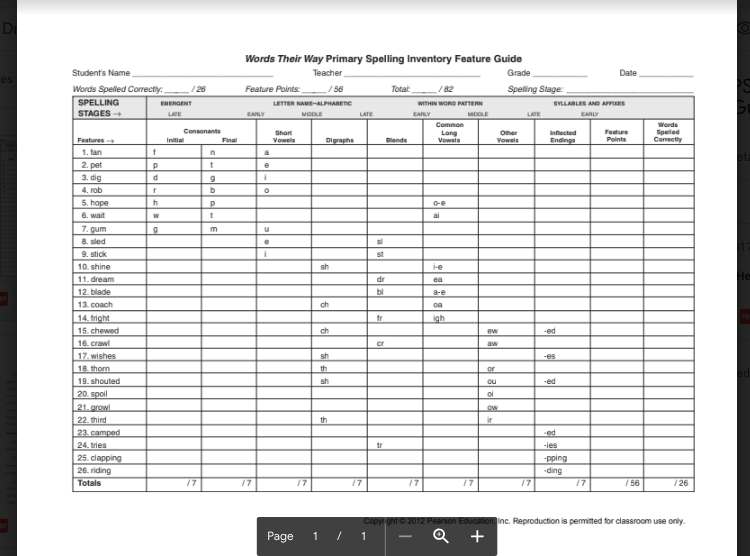
The Spelling Inventory from the Words Their Way series by Donald Bear is a spelling/ phonics program that my district adopted a few years ago. Part of this curriculum has teachers administer a spelling test 3 times a year, and adjust our students into strategy groups based off the results of that test. These tests contain 26 words that feature a variety of spelling patterns. The test is administered orally and students transcribe each word. The purpose of that assessment is to see what spelling patterns they have mastered and what they are ready to work on. With my grade level we take the primary spelling inventory and that focuses on skills ranging from initial sounds to inflection endings. When taking the test students get points for correct words spelled as well as spelling features used. Some assumptions that go along with this assessment are if a student masters the majority of the features in a column they are ready to move on to the next column of spelling skills. It can also be assumed that if a student spells the word correctly on the test they can spell all words similar to that pattern correctly. These are assumptions teachers can make as they move their students though the different skills. The scoring sheet for this assessment can be seen below.

Screen Shot 2019-05-19 at 4.25.56 PM

I enjoy giving this assessment as well as the program because it coincides with some of my beliefs with assessment which I discussed in my last post. This assessment drives my phonics and spelling instruction. From the results I can see where each student needs to focus, and I can cater my lessons to hit those focus areas, it also lets me know if I need to find a different approach to teaching a skill. Being able to drive instruction gives this assessment purpose which is another belief I have with assessment. I also am able to let students know the purpose of the assessment and include them on the “why” this assessment is something we do and how it helps myself as well as them with their learning.

In relating this assessment to the learning we did this week in CEP 813 Shepard’s article talks about how on-going assessment with constant feedback, as well as opportunities to transfer learned skills in routine, and evaluating instruction are some of the important components to think about when assessing. The spelling inventory is an assessment that when used appropriately can help drive instruction. It puts students into strategy groups  and gives them opportunities to learn skills in small segments.  This assessment is given throughout the year which gives opportunities for group changes and to provide students with feedback on how their spelling has progressed. Which makes the assessment a part of the learning.

After thinking about my learning this week as well as this assessment I have chosen to analyze,  I think the spelling inventory is a good example of assessment rethought in a way that makes it apart of the learning process. Which is what other assessment should strive for.

References

Bear, D. R., Invernizzi, M., & Johnston, F. R. (2006). Words their way. Celebration Press.

Shepard, L. A. (n.d.). The Role of Assessment in a Learning Culture. Teaching and Learning, 229-253. doi:10.1002/9780470690048.ch10

Assessment to me is…

As I begin getting my mind ready to start CEP 813, a course that really dives into assessment I have to stop and think what do I already know about assessment. How has my years of teaching shape my thoughts on assessment?

I have first and for most always believed that assessment should be used to drive instruction. If you are giving an assessment it should be used with fidelity and should be used to cater instruction. Once an assessment is given so much information can come from that. You can see if a topic has been mastered, or if reteaching needs to be done. You can use assessments to make strategy groups as well as map the next steps. Assessment can be the driving force behind what is being taught, since it gives data to back up instructional choices.

To build off of that thought, I also think assessment needs to have purpose. There are so many different assessment options out there as well as ways to assess. If there is no purpose or end goal with an assessment, giving that assessment is just a waste of time. If a teacher is going to take their time and a students time to give an assessment, there should be a purpose behind that assessment. Too often, I am given a test/ assessment to administer with my students and it has nothing to do with what I am currently teaching. So I am left to ask what is the point of this assessment?

Lastly I believe that students need to be apart f the assessment process, they need to know the purpose of the assessment as well as the expectations. For example, when my students are taking a pre-assessment I let them know that the content may be hard and it is meant for me to see what I need to teach them. When the students know the expectations it takes an anxiety away, and helps them to focus on the task at hand.

As I take time to reflect on what I already think when considering assessment, I am excited to build upon these ideas I already have, and gain a fresh new perspective on assessment as I complete this course. Stay tuned…

Questioning, and Reflecting

“Every student, everyday, no matter what,” we had an instructional coach join my district’s staff this year, and this was the quote she opened the year up with. I have found this quote easier to achieve since I have started my graduate course. I work in a low income school district and with that many barriers are thrown not only my way, but my students way. We talk about low test scores, and low parental involvement, and how that affects our students, but lately I have gone back to a TED talk from Linda Cliatt-Wayman, and her second slogan, “So what, now what?” If we feed into these barriers we are in turn holding our students back from the start. As an educator I make it my one goal everyday to hold my student’s to higher expectations instead of holding them back. In CEP 812 I have been inspired by Warren Berger’s, “ A More Beautiful Question,” and the anecdotes he uses to portray his point. In his 5th chapter I really was drawn to the story of Jacqueline Novogratz. She is a banker who works for Chase overseas. She notices that loans for young entrepreneurs with creative ideas are being denied do to lack of financial credentials. This made me immediately think of my students, so often because of their backgrounds, some teachers may think that they are not worth the extra time. That their creativity, and ideas may not amount to much, or they may never leave our small town. They are a product of their gene pool, and the apple rarely falls far from the tree. Our fearless leader of a principal constantly reminds us, that our DNA is not our destiny, and I couldn’t agree more.

In reflecting on how I make a difference I think to two recent compliments I have received. One from a former student who did not say it directly to me, but said as he was passing my classroom. He is a student I had a few years ago and I would call it my worst year I have had yet, with several challenging students. As he passed my room, he said to his Mom, now that teacher, she is just the greatest teacher, I wish I could have her every year. I was surprised to hear this from this particular student. His year with me was challenging but after reflecting I also remembered by the end of the year I knew his whole family, and that when he grew up he wanted to build the tallest building. With what he said in that moment I knew I had made a difference. The second was from my principal, who said as we wrapped up our meeting, that I knew my students in detail so well. I think the first step in being a successful teacher is knowing your students, the second step is engaging them, and the third is believing in them.

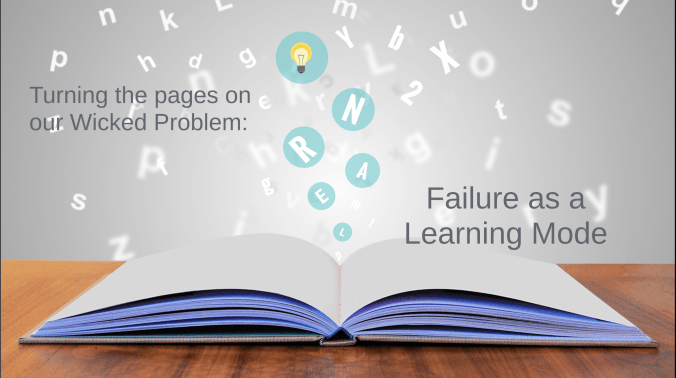
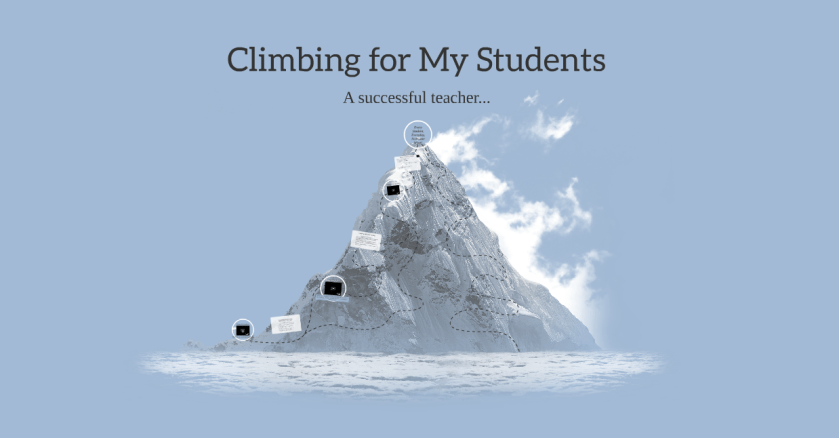
We live in a world that is constantly changing and I think that the system that is changing the slowest, is the education system. Thankfully, I have noticed that the younger teachers coming into the profession are geared for a change. They are geared with the knowledge to integrate technology effectively.  They know that, “The winners won’t just be those with more I.Q. It will also be those with more P.Q. (passion quotient) and C.Q. (curiosity quotient).” (Friedman, 2013) We live in a world where innovation is in the driving seat, and if we don’t teach passion and curiosity we are doing a disservice to our students. If we continue to drill and kill our students with facts rather than have them engage in discovery our world will eventually come to a stand still. It’s time we as teachers take risks, and invest in our students creativity. Learning may look messy, and it may take time but the results will be an engaging education for all. We will be able to reach “every student, everyday, no matter what. Below I have put together a Prezi which outlines my beliefs as a teacher when thinking about passion, curiosity, and failure in learning.

Screen Shot 2018-02-22 at 11.09.58 PM
If the Prezi cannot be accessed click here.


References:

(2015, June 05). Linda Cliatt-Wayman: How to fix a broken school? Lead fearlessly, love hard. Retrieved from https://www.youtube.com/watch?v=Xe2nlti47kA&t=4s

Friedman, T. L. (2013, January 29). Opinion | It’s the P.Q. and C.Q. as Much as the I.Q. Retrieved from http://www.nytimes.com/2013/01/30/opinion/friedman-its-pq-and-cq-as-much-as-iq.html

Berger, W. (2016). A more beautiful question: The power of inquiry to spark breakthrough ideas. Bloomsbury.


Sharing Solutions to our Wicked Problem: Failure as a Learning Mode

“Questioning is the ability to organize our thinking about what we don’t know,” several weeks ago our think tank came together to ask questions about our wicked problem: Failure as a Learning Mode, something at the time we did not know much about. Going into our research we each had so many questions, beautiful questions that we were determined to find answers for. We used Berger’s process of questioning using the why’s, what if’s, and how’s to narrow down our thinking and find a solution. It was interesting to see right off the bat, even from different educational backgrounds, we all had similar opinions on the role failure plays in the learning process. We knew the word held negative context, and the feelings behind the word were not positive either, so beginning to think of how we could spin failure into something productive was quite a challenge, as most wicked problems are.

Through our research we found that there were many studies about how the word failure needed to be reevaluated,  not only in classrooms but in the post education world failure was starting to be looked at as a positive avenue for change. As a group we discovered that the idea of a growth mindset was a must if educators were going to look at failure as a way for students to learn and grow. Many stories we read, about how failed attempts brought positive change reminded  me of where we started in this journey together, reading about Van Phillips and his innovations with prosthetic, in Berger’s A More Beautiful Question. If we teach students now that failure is a beautiful process in learning the results will be a world full of students who inspire inquiry.

Through our surveys we found that many teachers already believe that failure is a natural part in the learning process, but they just were unaware of how to encourage growth through their students missteps. As you will see in our Prezi, our solution lends a hand to teachers in finding resources and inspiration to promote a classroom environment where failing isn’t something scary, but something beautiful!

wicked-problem-project-failure-as-a-learning-mode

https://prezi.com/view/LkKVxriuzxOQV7hyQ8sq/

References:

Berger, W. (2016). A more beautiful question: The power of inquiry to spark breakthrough ideas. Bloomsbury.

The Right Question Institute. (2018). Retrieved from http://rightquestion.org/

Wicked Problem Survey

Dear Colleagues,

In an effort to collect information my Think Tank and I have put together questions to better understand our Wicked Problem, Failure as a Learning Mode. With your help we hope to move forward with our research and begin finding solutions to help aide this wicked problem.

Please consider answering this short survey about the wicked problem of Failure as a Learning Mode. in our professional context. There are 5 questions. It should take you about 5 minutes to answer them.

I have crafted this survey for an assignment that is part of my graduate program in educational technology at Michigan State University. I also hope that the results will inform discussions and planning for technology integration in the work we do together, and with students.

Your answers will be collected anonymously — please do not give your name or any other personally identifiable information. I will analyze these data and submit them for evaluation to my professors at MSU. I will share my analyses with you once they are complete. I really hope this survey helps us to gather data that we can use.

Thank you very much for your time and insights!

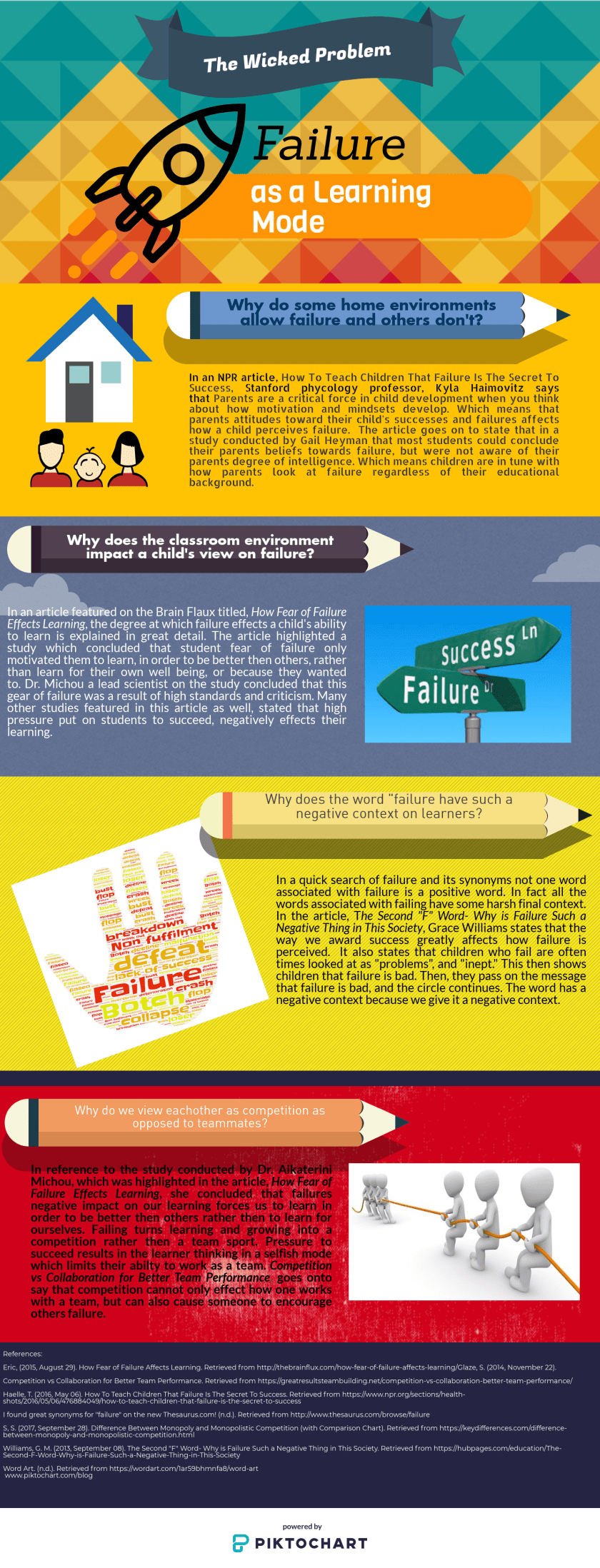
Failure as a Learning Mode Infographic

This week a group of us CEP 812 students go together with a common wicked problem our society faces, and that is looking at failure as a learning mode. In general the word failure holds such a negative context. When we fail the emotions we feel are frustration, and defeat. Those emotions are not something we were born feeling, it is learned helplessness. The four research questions our group decided to tackle this week surround the idea of why our society views failure negatively , and the environments that influence this perception. Those four questions are:

  1. Why do some home environments allow failure and some don’t?
  2. Why does the classroom environment impact a child’s view on failure?
  3. Why does the word(s) fail/failure/failing have such a negative context?
  4. Why do we view each other as competition as opposed to teammates?

This Info graphic below highlights some of the research I conducted this week in order to help my group better understand the answers to these questions.

failure-as-a-le_27795607 (1).png

The inforgraphic can also be viewed here.

References:

Eric, (2015, August 29). How Fear of Failure Affects Learning. Retrieved from http://thebrainflux.com/how-fear-of-failure-affects-learning/

Glaze, S. (2014, November 22). Competition vs Collaboration for Better Team Performance. Retrieved from https://greatresultsteambuilding.net/competition-vs-collaboration-better-team-performance/

Haelle, T. (2016, May 06). How To Teach Children That Failure Is The Secret To Success. Retrieved from https://www.npr.org/sections/health-shots/2016/05/06/476884049/how-to-teach-children-that-failure-is-the-secret-to-success

I found great synonyms for “failure” on the new Thesaurus.com! (n.d.). Retrieved from http://www.thesaurus.com/browse/failure

S, S. (2017, September 28). Difference Between Monopoly and Monopolistic Competition (with Comparison Chart). Retrieved from https://keydifferences.com/difference-between-monopoly-and-monopolistic-competition.html

Williams, G. M. (2013, September 08). The Second “F” Word- Why is Failure Such a Negative Thing in This Society. Retrieved from https://hubpages.com/education/The-Second-F-Word-Why-is-Failure-Such-a-Negative-Thing-in-This-Society

Word Art. (n.d.). Retrieved from https://wordart.com/1ar59bhmnfa8/word-art

On an Info Diet: Cutting Back on Information “Junk Food”

In 2010 I decided to join the masses of people on twitter. I was in college, and the excitement of tweeting my every thought and following whoever I wanted, was so new and fun. Fast forward 3 years, and as I entered the professional world, I decided to to a massive cleanup on my twitter of who I followed, and my interesting Sunday morning college thoughts, I just had to tweet. I even created a separate twitter for my classroom. Fast forward another 5 years and that brings me to this week, and another reflection of who I follow and what I post. Our lives and interests are ever changing, and if we do not keep up to date with what we post, follow and search, well, a flawed algorithm will do it for us.

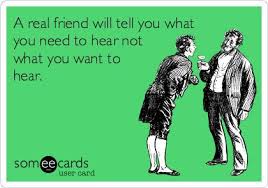
I found that wIth all the information across the world wide web, it is easy to overload on “information junk food.” (Pariser, 2011) I was surprised this week after listening to a TedTalk by Eli Pariser that what I search and click, effects what my search engine shows me. It had me thinking what am I not getting to see because these filters were trying to predict what I wanted to see? I noticed from my twitter homepage,  I enjoy reality t.v. a lot, fashion, and various education outlets. My first thought was, there wasn’t too much “junk food,” These were all things that I was interested in, however nothing of what I followed challenged my thinking. With the saying, Good friends will tell you what you need to hear, not what you want to hear, the internet was no longer being my good friend.

post

In wanting to clean up my Info diet, I decided to set some ground rules to follow, here on out when I am searching new ideas, or following new people/organizations. For every “mindless” search I make, whether it be celeb gossip or fashion, I will also search something of value, an education article or news outlet. In taking the advice of Gee, I will also embrace articles with different views, and opinions so I can be better educated in discussing new topics. (Gee, 2013) In thinking about finding organizations to follow that would contribute to our group discussions on our wicked problem, I decided for every new healthy information choice I made, I would cut out one junk food person/ organization that I followed.

Some new healthy choices I found on twitter, to contribute to my group discussion on our wicked problem, failure as a learning mode were; psychology today, education weekly, mindshift, and edutopia. All of these organizations tweet regularly, different articles, that I thought would really contribute to my knowledge, and discussions about failure as a learning mode.  I found these handles through searching #growthmindset, and #failtosucceed. To challenge my thinking I began following the National Education Association, although I agree with the intentions of unions, sometimes they are a bit too aggressive for me, so I wanted to be more educated about the issues they are addressing. I was even able to share an article from Psychology Today with my group that gave good insight to how we look at failure, and it paired nicely with a similar article another group member had shared. Some other healthy choices I made were following NWEA, Class Dojo, Brainology and Growth Mindset. In following my rule I unfollowed several celebrity handles and accounts that only flooded my feed with the same “mindless” memes. When I open my twitter feed I want it to be something of substance, and it is on its way there.

I had  #growthmindset this week while embarking on my info diet. Check out my Tweetbeam here to see what is trending with #growthmindset and #failtosucceed. To see how I cleaned up my info diet and get some ideas on how to clean yours up, check out my padlet.

References

Gee, J. P. (2013). Anti education era: Creating smarter students through digital learning. Palgrave Macmillan.

Pariser, E. (n.d.). Beware online “filter bubbles”. Retrieved from https://www.ted.com/talks/eli_pariser_beware_online_filter_bubbles

Tsaousides, T. (2018, January 23). How to Conquer Fear of Failure. Retrieved from https://www.psychologytoday.com/blog/smashing-the-brainblocks/201801/how-conquer-fear-failure

Some E cards. (2013, October 03). Retrieved from https://www.pinterest.com/pin/214554369721250298/