Formally [Re] Rethinking About Assessment

As part of one of my final assignments in CEP 813 I am using feedback received in editing a previous assessment I have created in 2 prior posts. This post serves as my final draft of my Formative Assessment Design.

In thinking about what to assess in our 2nd grade curriculum, I am over whelmed with options. In our core subjects (i.e. math, phonics, writing, and reading) we already have many assessments that we use effectively. However when it comes to social studies and science our assessments are severely outdated. They consist of matching and cut and past activities, that were created in the early 90’s. This is where I think our biggest need for assessment is. In thinking about where we are currently, in our science and social studies units, we are teaching the stages of the water cycle.

Purpose

The purpose of this assessment would be to see the students understanding of the water cycle, and the various stages in the cycle. This goes along with the Next Generation Science Standard:

Obtain information to identify where water is found on Earth and that it can be solid or liquid.

Performance Expectation

Grade: K-2

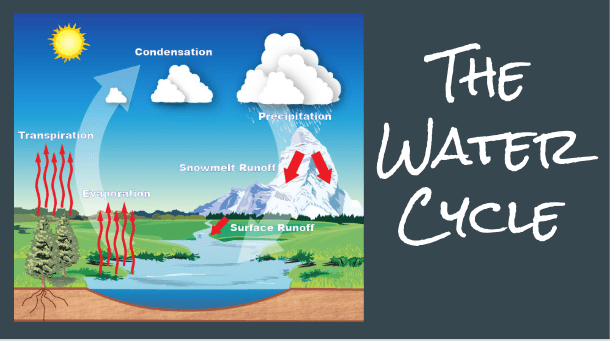
The instruction which I will talk a little more about next, will reflect the assessment at each stage taught of the water cycle. To explain better each day will consist of a lesson on the stage in the water cycle:

  • Day 1- Precipitation
  • Day 2- Run-Off
  • Day 3- Evaporation & Transpiration
  • Day 4- Condensation
  • Day 5- All together

After each day of lessons the students will have a chance to engage in the assessment and show their understanding of the stage we worked on that day, with the idea of building on that learning as we progress through the water cycle. Bt breaking it down step by step, I can check in with students and adjust instruction as needed to help them with their understanding. 
Assessment Design and Instruction
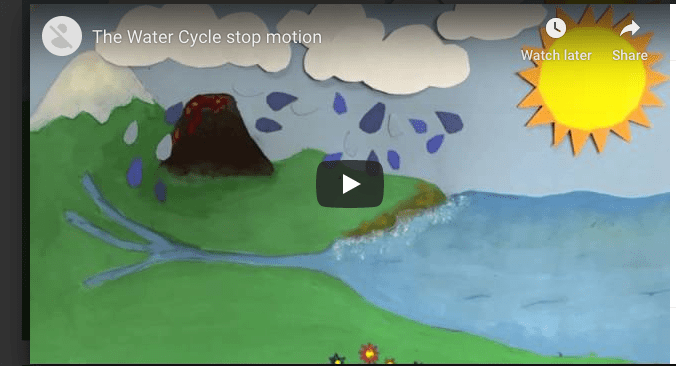
My thoughts for this assessment would be to have the students do a stop motion animation video of the water cycle. Apple has a great app for this called Stop Motion Studio. I have used it before with creating lego stop motion videos with my after school STEAM students. There would be some instruction that would have to happen prior to them making the video.  A good way to do this would be to show them examples of the videos, then create a video together, before letting them work on their own to create a video for fun. This pre instruction would help them explore the technology and find the best techniques that work for them when making their videos. This will also help to avoid any frustrations the students may have with using the new technology. To help them with making their water cycle video, I would give them cut outs of water cycle labels, raindrops, and clouds, which they could use as they move around to the different stages of the cycle. The end product would look similar to the video below.
Screen Shot 2019-08-14 at 9.00.43 PM
I can have the students work on different components of their stop motion video throughout the unit so I can see what they are understanding and what still needs more instruction. For example when we learn precipitation, they can add that piece to their video, and I can see their understandings of precipitation. This may mean there could be snow, rain, sleet, but either way I see their understanding of precipitation and where it fits in the water cycle.  By doing this I can alter instruction as needed based on their videos, making this project a formative assessment. Outlining how a day of this instruction would look would be as follows:
  • We would start with the lesson on precipitation
    • Starting with a presentation on the topic and showing examples
    • Next we would do a group guided activity to enforce understanding
  • Assessment: Show what you know-using the iPads you will create a stop motion video of just the precipitation of the portion of the video using the cut outs and your scenery.
  • Showcase: Students would be able to show their portion to a partner in order to get peer feedback on their video. They can adjust their video with their partner based on their feedback.
  • Review and Feedback: I would review their videos for that day, and adjust instruction for tomorrow by meeting with a small group to reteach in the morning. Or extend the lesson on that topic a day if I feel the majority of the class is needing further instruction. 

i would repeat this outline with the other stages of the water cycle.

Instructions

It will be clear to the students the water cycle can be demonstrated in many different ways as long as it has the components explained in the instructions which can be found here. With this being an ongoing project now through the unit, the instructions will have to change slightly, and instead of them adding each part in one sitting, the students will only have to work on one part of the cycle at a time. I think this will make for more creative time, and end with more detailed videos. So the instruction above show the outline for one day, and would change each day for the next stage we would be covering. However the outline would stay the same. The only change would be when they begin their video they would just be editing the previous video to add on to the clip. 

I outlined a day of instruction from the unit in this google slide which you can access by clicking the image below. This will also act as a place to display instructions as well as showcase student work by the students adding their link to the slide, which is a skill that is taught earlier in the year during research projects. 
Screen Shot 2019-08-14 at 10.06.54 PM

Feedback
The last thing I want to consider is feedback to the students as they finish and submit their videos. Using the 7 Principles of Good Feedback I have considered how I will use the video to create meaningful feedback for the student. To recap the students first look at their videos with a peer to talk about what they are showing in their video and what action the stage is taking. For example if we covered precipitation that day, the student would be talking about the type of precipitation they chose as well as what it is doing which hopefully would be falling from the sky. If their video does not show this correctly the students would need to open dialogue to help their partner realize their misunderstanding. Once they have had a chance to reflect and discuss their video with a partner they will have time to adjust anything before submitting it to me on the showcase slide. 
Once I have the videos I will review them and see if there is further instruction needed. 
On an individual level each student would get a rubric with 2-3 check points. The rubric would include:
  • Stage was displayed correctly in the video
  • Movement of the stage was accurate from where it goes in the cycle
  • Stage was labeled correctly

Each day after review of their videos the students will get their rubric/checklist to see which parts they completed. If they are missing parts they can have time to redo it before beginning their next stage in the cycle. If it is an individual or a few that need further instruction I will meet with them in a small group to clear up any misunderstandings an reteach before letting them redo their video clip. If the whole class is struggling I will re assess my instruction strategy and reteach extending the unit.

This type of feedback aligns with the 7 Principles very nicely. The checklist and rubrics show what the expectations of good work should be by giving a criteria. With their partner as well as with the rubric the students are given a chance to self reflect and make adjustments as needed. It shows the students where they are in the learning process by giving them the areas they did well as well as the areas they still need to work on in a single stage of the cycle. buddy feedback as well as teacher rubric feedback gives students a way to talk about what they are doing well on and gives opportunities to problem solve if there are parts that need work still. When students are done they are able to add their videos to the slide giving them time to showcase their work, understanding, and takes the assessment stigma away from it. With the information obtained from reviewing the videos I can meet with students on an individual to whole group level and close the understanding gap if students are still struggling. Lastly, I am able to adjust my instruction given the results of the video reviews. 

Technology
There are many forms of technology used throughout this instruction and assessment which I have explained throughout my post.  To discuss them a little further, the google slide is a technology used for the instruction. I like the idea of using this because it can act as an outline for each stage adding a routine to the instruction. It is also something that can be posted either on a website, or in an email which can make reviewing the learning easier. Within the google slide there are other forms of technology as well. Youtube videos mainly. One of the videos though shows a god example of the type of video I will be looking for as an end result, which is using technology to show the criteria I am looking for. 
The assessment itself is fully technology based with the stop motion animation videos. I chose this type of technology for a few different reasons. The assessment is meant to show the process of the water cycle. I felt this was best shown with a video that could be put on a loop to really show how the cycle continues. This type of assessment also allows for easy review by peers as well as me, the instructor. After I review it I can give them the feedback in the rubric so they can review their work and make anymore adjustments based of the rubric. Once complete, they will be able to embed their videos into the google slide so they can show case their work and understanding. By the end of the unit there will be a slew of videos which show all the students interpretation and understanding of the water cycle. 
In the end I am left with an engaging formative assessment that turns the learner into a director, and gives them the opportunity to showcase their understanding in a unique theatrical way. 
References

Nicol, D., & Macfarlane-Dick, D. (2006). Formative assessment and self-regulated learning: A model and seven principles of good feedback practice. Studies in Higher Education, 31(2), 199–218.

My Self Assessment on Assessment

As there are only a few short weeks of summer left, and I begin to think about the upcoming school year, I reflect on what I have learned in CEP 813 this semester and our discussions on assessment. In CEP 813 we spoke about assessment, and at the beginning of the semester  I posted about what I believed were 3 important thoughts to consider when thinking about assessment. If you want to read about my original thoughts that post can be found here. Although my thoughts have not completely changed, I do have some new thoughts, as well as, some reiterations on the thoughts I previously had on assessment.

My original beliefs on assessment as outlined in my blog post were that assessment should always drive instruction. Also, that assessment should always have purpose. In other words we as educators should never give an assessment without having a plan for that assessment. Last I thought that students need to be apart of the assessment, and in my post I mentioned pre assessments and expectations to be apart of involving students. Now that I have experienced CEP 813 and have a better understanding on assessment, I have some new considerations on my original thoughts. I still think my beliefs have an importance in the role of assessing but my thoughts on their importance are more clear now.

First when thinking about how assessing should drive instruction. I originally thought that meant looking at an assessment and seeing where to go next in teaching. Which is a pretty simple thought in the grand scheme of assessment. According to Wiggins and McTighe, we need to look at assessment and planning in the view of a  designer. “Good design, then, is not so much about gaining a few new technical skills as it is about learning to be more thoughtful and specific about our purposes and what they imply.” (Wiggins & McTighe, 2005) The article goes on to talk about how in order to obtain the desired results we as educators need to consider the lessons and units leading up to the desired results. We can have the most amazing lessons ever but if they are not considering the desired results of the assessment then they are really not serving their purpose. Taking one more step back, if we are not considering how the students will benefit from the lesson to achieve the desired result, then truly we are wasting our time. By taking a backward design approach, all of the steps leading up to the assessment are carefully thought through, and are designed around the end result. Which leaves the teacher with an assessment that truly does reflect the lessons taught. I make this the first point in my ADC 3.0 as I talk about how lessons and assessments should effect each other.

My next thought from my original post was that assessment should have purpose. I do think now this goes along with lessons reflecting assessment, however, this is a belief I still have. Shepard reaffirmed my belief when she stated, “The content of assessments should match challenging subject matter standards and serve to instantiate.”(Shepard, 2000). To me this statement defined what purpose was to me when I thought about assessment. My original thought on this belief was sparked, as my district adopts a new reading curriculum. While we were unpacking the curriculum we were left with almost 8 possible ELA assessments we could give. That is an overwhelming number of assessments, some were redundant, some had upgraded approaches. However, until we found the purpose of using these assessments we could not determine which would be used. After taking this course I feel that I have some new ideas to consider when thinking about purpose with assessments. After working on my formative assessment design, I had to think about what the purpose of that assessment would be. Originally I had it set up as a summative assessment but after some tweaking I was able to make it a formative assessment. When creating assessments knowing the difference between the two assessments, can change the purpose of the assessment tremendously. In terms of the assessment I designed on the water cycle the purpose of each step assessed would tell me if the students understood the process.  So thinking about the purpose and designing lessons around that purpose is very important. When thinking about how to apply games to assessing I had to consider the purpose as well, when putting my game together. I had to think about procedural rhetoric and apply that to the purpose (semiotic domain) of what I wanted the students to learn as they entered the world of words.

Lastly, I thought originally that students should be apart, of the assessment process. I articulated this in my first post by saying they should have clear expectations. Now I think that is only a small fraction of how you can involve students in the assessment process. From feedback, to self evaluations students should have almost an equal role in the assessment process. Hattie and Timperley talk about how feedback can support learning gains by offering students a chance to revise, tune and rethink their work (Hattie and Timperley 2007). However, that feedback has to be effective. Not a simple nice job. Using my ADC 3.0 I outlined this by using the 7 principles of good feedback. I demonstrated this even further in my Game based assessment when giving students specific feedback after each level played. I went a step further with that game, at the end  by giving them time to to reflect and decide if they need more practice, or more time to review, or if they feel good and are ready to move on. Including students in the reflection process is a a great way to gauge how they feel about their understanding. Another great way I have gotten to apply feedback was using my Classroom Management system which I spoke about in a previous blog post. I found that CMS’s make assessing as well feedback more convenient and purposeful.

I have continued to keep my beliefs on assessment but, through my work in this course I have been enlightened about my original ideas, as well as, have some new thoughts on assessment. One of those new thoughts are that assessment needs to take on a new look. They need to be more engaging. As talked about in Mishra and Mehta’s 2017 article we are assessing 21st century learners using 20th century type assessments. Although this is not something that can be controlled with standardized tests we can control how we assess in our classrooms, and take the steps to make assessments more engaging. Another thought that I have about assessments is that we as teachers need to make assessing easier for us. These essentially are tools for us to use to drive instruction, and by using technology as well as a backward design approach to developing our assessments, they can aid our teaching in a whole new way. Sams and Bergmann do a really great job of showing how a flipped classroom can work to engage the teacher and the student in to 21st century learning and assessing and have given me new thought as I consider to using CMS’s and Electronic Assessments. “Education is for everyone, but the way in which we deliver education and the way in which students receive it is not the same for everyone.”(Sams & Bergmann, 2013) CMS, and Electronic Assessments make learning more engaging and accessible for all, and give the teacher access to new forms of data that previously they may not have had.

Overall this course challenged me more than any other course I took in the MAET program. I rethought every think I already knew about assessment, and I am excited to apply my new knowledge as I dive into the upcoming school year. Whether it is rethinking some old outdated assessments, or creating new digital assessments, I feel equipped to take on assessing my 21st century students using 21st century skills.

References

Gee, J. P. (2003). What video games have to teach us about learning and literacy. New York, NY: Palgrave Macmillan.

Hattie, J., & Timperley, H. (2007). The power of feedback. Review of Educational Research, 77(1), 81–112.

Mishra, P., & Mehta, R. (2017). What we educators get wrong about 21st-century learning: Results of a survey. Journal of Digital Learning in Teacher Education33, 6-19.

Nicol, D., & Macfarlane-Dick, D. (2006). Formative assessment and self-regulated learning: A model and seven principles of good feedback practice. Studies in Higher Education, 31(2), 199–218

Shepard, L. (2000). The role of assessment in a learning culture. Educational Researcher, 29(7), 4-14.

Sams, A., & Bergmann, J. (2013). Flip your students’ learning. Educational Leadership, 70(6), 16-20.

Wiggins, G. P., & McTighe, J. (2005). Understanding by Design (Vol. Expanded 2nd ed). Alexandria, VA: ASCD.

I Just Took a DNA Test Found Out…

Typically if you told me I had to take a test on DNA replication, I am sure there would be about a million other things I could think of that sounded better to do. I have never been the best science student, and I get quite anxious I wont do well. It has also been a very long time since I have taken any sort of science class and have probably not heard these terms in over 10 years. When I think about how I feel as I prepare myself for this DNA Game Based Assessment I am about to take, I think about the student that may feel like this in class. There are always 1 or a few students who do not feel ready or confident in their abilities when they are faced with an assessment. As I play the game… I mean take the assessment I am channeling my inner student to see if this assessment checks all the boxes and engages me in the topic, and enhance my learning.

As I enter the game PLAY shows up in many large letter which immediately takes a bit of the anxiety away. This no longer has the look of a test which makes me feel a bit at ease. In the game I am given the role of a super hero which can look at cells more closely, my mission is to replicate a DNA cell. When I begin, I am tasked with finding the first step in replicating DNA. I am given three options, I guess correct. Key word guess, and it takes me to the next challenge, had I gotten it incorrect I would have some feedback and a chance to retry which was very helpful. I find the DNA molecule though and am able to move on. I answer the next challenge I get wrong right off the bat, but with the feedback tells me where I will need the step next. As I progress through the game you need a solid background in the terminology and process to be able to answer the questions right the first time. Although I could guess my way through, there is opportunities for self reflection if you want to watch a youtube video which explains the replication process. Playing the game with my husband who is much better with science and terminology than myself, I aided some help from him. We were both wanting more at the end when we were hit with a to be continued and even ended up googling  Watson and Crick Fragments, as well as Okazaki Fragments to see if we were correct.

This game is both a challenge and a learning experience. The creator (my classmate) did a great job of making this a time for leanring, and I felt no frustration while progressing through the adventure. The feedback on answers was so helpful, when knowing what cam e next. Giving the opportunities to take time and watch videos brought a a great multimedia component to the game which made it very engaging. I can honestly say I did not feel defeated by this game once as I was playing for as many answers as I got wrong.

When comparing it to my ADC 3.0 though there are some components I would want to see. The assessment did have a clear objective which is stated at the beginning, and there were lesson type components in it that could have directly came from lessons taught. That being said, There was not a clear success criteria that I saw. Perhaps I could see that the steps to replicate could be a success criteria, and if I had more knowledge of the content that may have been more visible. As far as feedback and self reflection it is throughout the whole game as you get steps right and you need more work. When you are able to pick between going on or taking time to learn the students are self reflecting, and each step gives a tid bit of feedback to consider before you move on.

When thinking about assessment design and this game, it is off to a great start. I think as the game progresses in design it will check more of the assessment design boxes I was looking for. As it is though it gives some great feedback to students as well as opportunities to improve their understanding. I do think that there is opportunities for students to just guess their way through, however with Twine I do not think that is something you can help right now.

I was taken back to my high school days with this DNA replication game, and think that I would have had more success had my teacher had a game like this.

Word Game: A Game Based Assessment

The teenage boy making headlines, for winning 3 million dollars in a Fortnite Tournament is making headlines, and convincing parents all over that video games may not be a waste of time after all. In fact as a society video games and playing video games have a stigma around them, that they are not a productive use of time. As video games become more popular with students of all ages finding ways to use them in our instructional day could show a slew of benefits. Mainly in the area of student engagement. Think about it, whether it be Super Mario Brothers, or Candy Crush there is a fixation with getting to the next level, getting more points, and improving. What if we could pull that engagement for the greater good of our classroom assessments? The game I have designed is made to do just that.

Overview/ Objective:

In the game the student will become the word worker, and will go on a journey to defeat the Word Wizard, who has captured the Dictionary Damsel. The Word Worker must solve each riddle by identifying either the antonym, synonym, or homonym. If they get the riddle correct they move on to the next riddle, if they get it wrong though they are redirected to a review station, and start over. They Have 7 riddles to solve in order to save the Damsel. This goes along with 2nd grade Language standards which help students to identify word meaning. With each riddle there is one correct answer as well as 2 incorrect answers meant to trick the player.

External Grammar:

Students will have to draw on their knowledge of word meaning to help them solve each riddle. The different types of words will be reinforced throughout the game, giving students multiple times to review with short videos on antonyms, synonyms, and homonyms. Students will have to understand the types of words and be able to identify them in order to move on.

Internal Grammar:

The students will have to understand how the words relate to each other. In some of the riddles both synonyms and antonyms occur. So the students need to know the relationship between the words they are searching for. They will have to read the sentence, and then be able to decipher what words are the words they are looking for. The adventure will take them to either a congratulations page, or a review page to help them understand better if need be.

Procedural Rhetoric:

When the game starts you are taken to the first riddle. At the top it tells you the relating words you are looking for whether it is synonyms, antonyms, or homonyms. Then as the player reads the riddle they are faced with 3 word options. If they choose the right one they are brought to a congratulations page with the link to move on to the next riddle. If they choose incorrectly they are to directed to the review page where they watch 2 review video then start over. 1 of the videos is on antonyms and synonyms and the other is on homonyms. Once they have successfully completed all riddles the last page asks them to either finish the game or start over if they feel they need more practice. Thinking about this page a little more I cold really split it up into 2 reviews, so I can see if more students are getting hung up on synonyms and antonyms or homonyms and adjust my instruction based off of that. For right now thought the review is together.

GBA and My ADC:

When thinking back to my assessment design checklist. I feel that the Game Based Assessment hits many major parts. It has lessons embedded in the game with the review page, These videos could easily be used in lessons to help the assessment reflect the lessons taught. With the welcome page the objective of the assessment is clear, as well as the success criteria. With each question there is a place for review but I think along with the review link I could also offer some more meaningful feedback they can consider for their next round. At the end students are able to self reflect by either being done, if they think feel they are successful, or starting over for more practice. So all in all the assessment hits the major questions, and i feel it will really engage students into the content.

The game I created to take students through a journey of words can be played using the link here.

There are Many Different Ways to Take a Test

While teaching lower el, I have noticed a pattern in behavior with students as they transition from GSRP to Kindergarten. In GSRP the role of play is the center of their curriculum it is how they learn and explore the world around them, which makes the transition to Kindergarten pretty tough, when the curriculum is more concrete and leaves little time for play… or does it. What if there was a way 

By taking more time to allow play and games the return on knowledge obtained could possibly be greater. When thinking about how I can incorporate games into my assessments I thought the easiest way to do this would be with grammar. Gee talks about semiotic domains as a variety of forms that take on meaning. The semiotic  domain my assessment will focus on grammar as it applies to synonyms, antonyms and homonyms. Internally and externally there are principles of pattern tat govern how these types of words are looked at. There are a set of rules and procedures for classifying these words. Typically we teach these types of words in the third half of the year in second grade. To assess the knowledge obtained from the lessons, I would like to attempt to use a game that will be designed using the software twine.

Game Design

The students will take the role of the word wizard as they progress through the game there will be a set or word challenges where they have to solve a riddle to find the words that are related. Using the riddle they will have to decide what two words in the riddle are related and if the words are antonyms, synonyms or homonyms. If they pick the correct choice they will move on to the next challenge if they do not they will start back at the beginning. An example of a riddle challenge would be:

Find the Homonym:

On my birthday there was cake, with eight bright candles. I turned on the light and I ate it all up. Then put my fork down

The options to move on would be:

Bright, light

Up, down

Eight, ate

If they get it right they will get a congratulations message where they can move onto the next challenge. If they get it wrong there will be a message stating it was wrong with an explanation of a homonym to help them next time, from the reinforcement message they will go back to the beginning to get more practice. I am considering also having pictures included in this journey of grammar challenges. There will be 9-10 levels with grammar challenges before the end where they will get a message letting them know how well they did. 

Using my assessment design checklist I feel that my assessment will be a direct reflection of the lessons taught on grammar. At the beginning of the game there will be a welcome message that clearly states the objectives and give a brief overview of each of the word types. The success criteria will be present in the welcome message as well and will set the stage of the game. AS the students progress through the game correct or not they will receive meaningful feedback with the students seeing how they did and getting reinforcement messages if they need help. I am not sure how they can self reflect yet but with this being a work in progress, I am sure I can find a place for reflection in this game/ assessment.

As I continue the design process I hope to create an assessment that is masked in fun and engagement.

Gee, J. P. (2003). What video games have to teach us about learning and literacy. New York, NY: Palgrave Macmillan.

Assessment Design and CMS

How can I make assessing easier for me next year? That is what I thought about when I chose the assessment I created using my district’s CMS which is Illuminate. I wanted an assessment that could be quick and give me as much information as possible. So having already played with item bank and on the fly assessments, I chose to use an illuminate assessment I do not typically use which is a skills assessment. These assessments can be a list of words, problems, or pictures. I know a kindergarten teacher I work with uses them for rhyming. She shows the student a picture and they have to give her a word that rhymes with the picture.

For my assessment I chose to do an assessment on long and short vowels. Within the assessment I have a mixture of the different vowels in long and short vowel form. What I like about the skills assessment is that the students can see at the end how they did. I can also print out flashcards for them for practice. I can also take notes on each attempt to refer back to, as well as give notes to parents in a parent letter on the assessment. In the assessment I can link standards so that I have a purposeful teaching point. One set back of this assessment is that it has to be given individually so it will take some time, but the information taken from that one to one assessment will be worth it in the end.

As far as my ADC goes the assessment checks a few of the boxes. This assessment can guide my next lessons based off of how the students do I can reteach the standard in large or small group depending on the needs. The assessment also has a place for feedback and self reflection as the students are given materials to practice from the assessment report when they have completed the assessment. I think some things I need to think about is how the students can show understanding with this assessment. This is definitely a first draft as I think of ways to improve using skills assessments. However, it was my first time using these types of assessment and I am excited to see other ways I can use them.

A quick look at my assessment can be seen here.

Illuminating Assessment and More

In looking at Classroom Management Systems this week in CEP 813, I decided to take a look at the system which my district uses which is Illuminate Education. We began using this system 3 years ago and I can honestly say I learn more from this system every year. It has so much to offer in terms of Data and Analysis of a classroom and it keeps getting better. As of a week ago Illuminate announced it was merging with four other classroom management systems in hopes of adding even more functionality to its platform. With looking at this system now and what it offers, these are the functions of illuminate as a CMS:

Assessment:

Illuminate has a great assessment section. There are so many options for creating and administering assessments. Some choices that it gives you to create assessment, is to write it out yourself through illuminate, choose from an item bank which gives a variety of questions to choose from, or download content to create an assessment.  The questions range from multiple choice to essay questions. Then to administer you can administer it online through the student portal, with a bubble sheet,  one on one assessment through skills assessment, and paper pencil assessment. Assessments administered through the student portal give real results to let students and parents know how they did. However, as far as feedback goes, teachers are given more information than students are. So it is left to the teachers to interpret this information to the students.

Reports:

Once the assessments have been administered pre built reports are made to show the teacher how the students are doing. It can focus on standards and the percent of students who missed certain standards, as well as show as a whole how many students mastered the assessment. There is even a student grouping report which can help to make small strategy groups. You can even create custom reports which you can set objectives for based on what you are trying to look at. One of the prebuilt class reports even shows reasoning for why a student may have gotten a question wrong, so it can help guide teaching.

Attendance:

From this CMS you can take attendance, and track attendance. This can help in conferences when discussing why a student may not be performing well. When a student is absent for so may days it affects their at risk number as well which can determine if a students attendance will effect their academic performance. The student attendance report can also be viewed in parent portal.

Gradebook:

Assessments can also be linked tot the grade book, which can be viewed through parent portal as well as on the report card. The grade book makes it easy to organize assignments, and link artifacts to the assignments. The grade book allows the teacher to enter standards to the assignment, and see which students are missing those standards.

Student/Parent Portal:

Students and parents can access their portal and view progress, as well as assessments that are needing to be taken. Teachers can message parents through the portal, and teachers can also see if other contact has been made with the parents from administrators and support staff.

Privacy Policy:

The privacy policy for illuminate can be viewed here. Some points from their policy I want to touch on though are; that illuminate assigns a special domain for the district you are a part of which adds security to the information being obtained. Illuminate also does not share any teacher or student information with any third party.

Functions that this platform is still lacking is student engagement. Many of the secondary teachers in my district use google classroom, because it holds that student engagement piece. Although students can log in and complete assessments as well as see how they are doing, they cannot engage with each other through the portal. There is no discussion forum or blog for students and teachers to engage which would be critical in making this a a good platform for blended leanring. Along with that being able to assign lessons and assignments is not something that can be done with this program. So because of that you really would not be able to do any sort of blended learning or flipped classroom. Hopefully this is something that can be added in the future because this platform for managing student information, and informing parents about student progress has some great components.

Assessment Design Checklist-CHECK-Looking at My ADC 3.0

Over the last several weeks I have been forming a checklist that can be used to form and administered effective assessments. This has been a labor of love, and has really evolved from my first edition which only had 2 questions which are not even included on my final edition f my checklist.

My ADC 3.0 was evolved mainly through the feedback I was given. Between feedback through video and google docs, I have been able to see gaps in what I am missing and adapt my checklist to fill those gaps. Really, this process of adapting my checklist is very similar to the components of my checklist. Lessons were taught around what I would include in my checklist, the objectives were clear through the CREATE tab in D2L, the success criteria was also present on D2L, I was given feedback in various forms, and I have had time to reflect on my ADC both through my feedback, as well as using it to critique a peers assessment.

So in a way the assignment of the ADC checks all the boxes on my ADC making it a very successfully administered assessment. Which shows how assessments bring lessons full circle.

Formally Rethinking About Assessment

Feedback has been the theme for my CEP 813 class this last learning cycle. My last post talked about my Assessment Design Checklist, and some updates I made to that based on feedback I received. This post will be about updates I made to my formative assessment I am working on.

If you did not read my last post on my formative science assessment, I planned an assessment where my students would recreate the water cycle using stop motion animation.

The purpose of this assessment would be to see the students understanding of the water cycle, and the various stages in the cycle. This goes along with the Next Generation Science Standard:

Obtain information to identify where water is found on Earth and that it can be solid or liquid.

Performance Expectation

Grade: K-2

My thoughts for this assessment would be to have the students do a stop motion animation video of the water cycle. Apple has a great app for this called Stop Motion Studio. I have used it before with creating lego stop motion videos with my after school STEAM students. There would be some instruction that would have to happen prior to them making the video. A good way to do this would be to show them examples of the videos, then create a video together, before letting them work on their own to create a video for fun. To help them with making their water cycle video, I would give them cut outs of water cycle labels, raindrops, and clouds, which they could use as they move around to the different stages of the cycle. The end product would look similar to the video below.
After some feedback that I received from my FAD 1.0 some items in my assessment purpose I want to clarify or add onto is that through my instruction, it will be clear to the students the water cycle can be demonstrated in many different ways as long as it has the components explained in the instructions which can be found here.
I realize now that this assessment seems more summative, rather than formative, but I think I can make some tweaks to make it more of a formative assessment. More clearly, I can have the students work on different components of their stop motion video throughout the unit so I can see what they are understanding and what still needs more instruction. For example when we learn precipitation, they can add that piece to their video, and I can see their understandings of precipitation. This may mean there could be snow, rain, sleet, but either way i see their understanding of precipitation and where it fits in the water cycle.  By doing this I can alter instruction as needed based on their videos, making this project more like a formative assessment.
With this being an ongoing project now through the unit, the instructions will have to change slightly, and instead of them adding each part in one sitting, the students will only have to work on one part of the cycle at a time. I think this will make for more creative time, and end with more detailed videos.
The last thing I want to consider is feedback to the students as they submit their videos. I have considered two types of feedback, and after reviewing Hattie and Timperleys’ article on The Power of Feedback. One consideration I have for feedback is doing a screencast of their videos so hey can hear the feedback. The students would get to watch a screencast of their video so they can make adjustments to their next video. Another consideration I have is to do reinforcement lessons as we watch their video together. That way I can see if they have a better understanding of the concept taught that day. I can also cater the lesson to their specific needs, based off the misconceptions viewed in their video.
With the amount of technology being used already in this assessment, I am gravitated toward doing small reinforcements, after seeing what each student needs. I think so far this assessment will step up the engagement on science tests.

Hattie, J., & Timperley, H. (2007, 03). The Power of Feedback. Review of Educational Research, 77(1), 81-112.

Room for Improvement

I recently have welcomed a beautiful baby boy into the world. However, with he being only 5 weeks old, I am left to guess constantly what he needs. Although the choices when he begins crying is limited to a few options, his lack of words leads me to go through the list myself. This guessing game I play with him on a daily basis reminds me of my learning this week in CEP 813 on feedback.

In a way his feedback engages me into our learning of each other, however the lack of direction can lead to subtle frustrations between both him and myself. It reminds me of how feedback needs to engage with out telling the learner explicitly what they are missing. It should be an extension of  the learning.

As I thought about feedback as it pertains to my Assessment Design Checklist, I used my feedback given to me with my previous model, to improve my questions and reasoning. I also added a section where I consider feedback with the assessment I would administer. It is a work in progress but feedback is always welcomed.