Maker Education is something that I was introduced to a few years ago when attending the MACUL conference. Since then recreating my classroom into a maker space has been something I have aspired to do. CEP 811 has given me such great information to contribute to this vision I have for a student centered room, filled with learning experiences.
As CEP 811 winds down we were asked to reflect on our progress in the making process, and explore ways to promote #MakerEd to others using all this new research. I was truly inspired by the 3 different maker spaces that were researched in one of the articles we read titled, Learning in the Making: A Comparative Case Study of Three Makerspaces. This study showed that there is no right or wrong way to create a space for makers to grow. Just as long as the essentials are included. Acorss the board all three spaces had collaboration, limited boundaries, and a diverse social group with common goals. Thinking about that in a classroom setting this can seem overwhelming, so I included an infographic to show the positive effect #MakerEd can have on students.
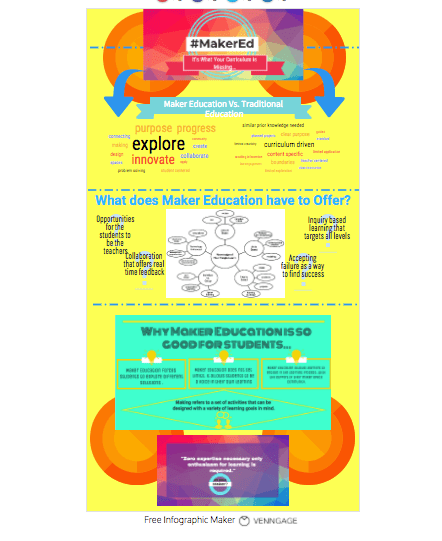
Using maker education we can open doors for students to explore ideas we never even imagined was possible. Maker education makes equitable learning possible, and teaches students to create a community that fuels learning. In a world where anything is possible choose #MakerEd.
References:
Figure 2f from: Irimia R, Gottschling M (2016) Taxonomic revision of Rochefortia Sw. (Ehretiaceae, Boraginales). Biodiversity Data Journal 4: E7720. https://doi.org/10.3897/BDJ.4.e7720. (n.d.). doi:10.3897/bdj.4.e7720.figure2f
Sheridan, K. Halverson, E.R., Litts, B.K., Brahms, L, Jacobs-Priebe, L., & Owens, T. (2014) Learning in the making: A comparative case-study of three maker spaces. Harvard Educational Review, 84(4), 505-565
Halverson, E.R. & Sheridan, K. (2014). The maker movement in education. Harvard Educational Review, 84(4), 495-465.

 Learning with Lindsay